
- Quick Answer
- What did the Supreme Court decide about AI-generated fake citations?
- What is the Bar Council of India's position?
- Why do AI tools invent case law?
- Can lawyers and students still use AI?
- How do you verify an AI-assisted citation?
- How does VMLS train students to use AI responsibly?
- Sources and further reading
- Frequently Asked Questions
Quick Answer
In July 2026 the Supreme Court set aside tribunal orders that relied on non-existent, AI-generated judgments and signalled that citing unverified AI output can amount to professional misconduct, so every citation you use must be checked against an official source.
What did the Supreme Court decide about AI-generated fake citations?
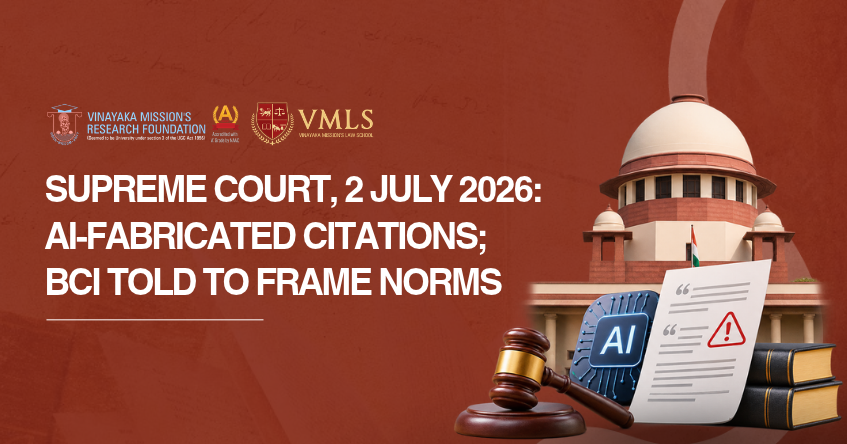
On 2 July 2026, in Pooja Ramesh Singh v. Jammu and Kashmir Bank Ltd. (2026 INSC 668), the Court found that the NCLT had relied on non-existent judgments and AI-generated extracts wrongly attributed to genuine Supreme Court decisions. It set aside the NCLT and NCLAT orders, held that citing such judgments without verification can amount to advocate misconduct, and asked the Bar Council of India (BCI) to frame norms. The warning had been building: on 17 February 2026 the Court had already flagged lawyers filing AI-drafted petitions with fake citations.
What is the Bar Council of India's position?
The BCI has told Parliament that advocates who file fake citations, fabricated quotations or non-existent judgments cannot escape professional liability by blaming technology. Responsibility stays with the signing lawyer.
Why do AI tools invent case law?
Generative AI predicts plausible text; it does not look up verified records. A fabricated citation can therefore have the right format, a believable bench and a convenient holding, and still not exist. Three warning signs: (1) the reporter citation does not match the case name when you search it; (2) the quoted paragraph cannot be found in the real judgment; (3) the holding fits your argument suspiciously well.
Can lawyers and students still use AI?
Yes, with verification. The Supreme Court's AI guidelines for the judiciary allow uses such as case listing, docket analytics, legal research support and translation. The line is between AI assisting research and AI substituting for it.
| Lower-risk use | High-risk use |
|---|---|
| Summarising a judgment you have already read | Asking AI "which cases support X" and pasting the answer |
| Translating a judgment, then checking the translation | Quoting AI-generated paragraphs as the Court's words |
| Brainstorming issue lists and moot structure | Filing AI-drafted pleadings without line-by-line checks |
How do you verify an AI-assisted citation?
- Treat AI output as a lead, never as authority.
- Find the judgment on an official source: the Supreme Court or High Court website, eCourts, or India Code for statutes.
- Match the details: case name, court, date, bench and citation.
- Read the cited paragraph yourself and copy the exact wording from the official text.
- Check later history: was it overruled, distinguished or stayed?
- Keep a verification log listing each authority, the source you checked and the date.
The same discipline you build in a moot court protects your credibility in practice. For the wider picture of AI in litigation, see how DeepSeek's AI is shaping litigation support.
How does VMLS train students to use AI responsibly?
Vinayaka Mission's Law School (VMLS), Chennai, is mentored by O.P. Jindal Global University and builds citation discipline through moot courts, written assignments and internships. The LL.M. in AI, Emerging Technologies and IPR examines AI regulation directly, and the school has hosted a guest lecture on copyright and AI.
Train for the AI era at VMLS: apply for LL.B. (Hons.) or LL.M. 2027-28 →
Frequently Asked Questions
No. The risk lies in filing unverified output. The Supreme Court's concern is fabricated authority, and responsibility rests with the lawyer who signs.
Pooja Ramesh Singh v. J&K Bank Ltd. (2 July 2026) set aside NCLT and NCLAT orders built on fake AI-generated precedents and asked the BCI to frame guidelines.
Academic rules apply in law school, and advocates face disciplinary action. Verification protects you in both settings.
Use official court websites and eCourts services, and India Code for statutes, rather than AI summaries or unsourced blogs.
Sources and further reading
- Bar & Bench: Supreme Court declares zero tolerance
- Bar & Bench: what the BCI told Parliament
- LiveLaw: Supreme Court raises concerns, 17 Feb 2026
- Bar & Bench column: what the AI Impact Summit means for legal practice
Register for VLAT-based admission at VMLS, Chennai →
This article is educational and is not legal advice.