
- Quick Answer
- What are the four labour codes?
- What is the status one year later?
- Which changes matter most to employers and workers?
- Why are gig workers central to the debate?
- What should an employer do in the next 90 days?
- Which careers does labour law offer?
- How does VMLS connect labour law to practice?
- Sources and further reading
- Frequently Asked Questions
Quick Answer
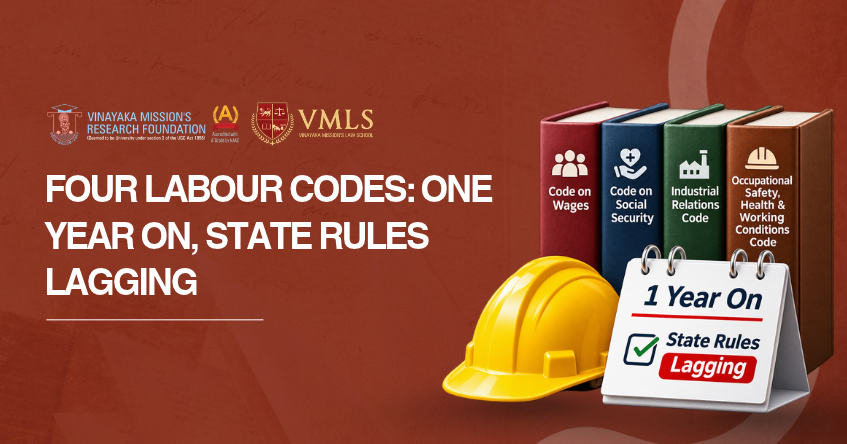
India's four labour codes (wages, industrial relations, social security, and occupational safety) came into force on 21 November 2025, replaced 29 central labour laws, and are now being put into practice through central rules notified on 8 May 2026 and state rules that remain uneven.
What are the four labour codes?
| Code | Covers | Laws consolidated |
|---|---|---|
| Code on Wages, 2019 | Wages, minimum wages, bonus, equal remuneration | 4 |
| Industrial Relations Code, 2020 | Unions, standing orders, layoffs and retrenchment, strikes | 3 |
| Code on Social Security, 2020 | Provident fund, ESI, gratuity, maternity benefit, gig and platform workers | 9 |
| Occupational Safety, Health and Working Conditions (OSH) Code, 2020 | Safety, health, working conditions, contract labour | 13 |
Together they repealed and replaced 29 central labour laws.
What is the status one year later?
At the Centre, rules under all four codes were notified on 8 May 2026, and central registrations and returns are operational. States are the slower link because labour is a concurrent subject. In September the Labour Secretary said all states and Union Territories were expected to notify rules by 31 October, but tracking cited in November showed that only six of 37 states and UTs had notified rules under all four codes by October 2026, with about ten having notified at least one. Always check the relevant state's current rules, Tamil Nadu's included, before advising an employer.
Which changes matter most to employers and workers?
Commonly highlighted changes (verify each against the bare Act):
- Wages: components excluded from "wages" cannot exceed 50% of total remuneration, which can raise the base for provident fund and gratuity.
- Fixed-term employment is recognised, with gratuity after one year of service.
- Appointment letters are mandatory.
- Industrial Relations Code: the threshold for standing orders and for prior approval of layoffs, retrenchment and closure moves to 300 workers, and strike notice of 14 days applies across establishments.
- Gig and platform workers are recognised in law for the first time.
Why are gig workers central to the debate?
The Code on Social Security defines gig and platform workers and aggregators, and provides for aggregators to contribute a share of annual turnover (1-2%, capped at 5% of amounts paid to such workers) to a social security fund. The November 2026 reporting points to delays in operationalising the social security provisions, particularly for the gig economy. Open questions include worker classification, scheme design and how state gig-worker laws interact with the Code.
What should an employer do in the next 90 days?
Our reading: treat this as a compliance project, not a legal memo.
- Audit pay structures against the 50% wages rule.
- Refresh appointment letters and standing orders.
- Map every establishment by state and track each state's rules.
- Review principal-employer and contractor responsibilities.
- Check exposure if you use gig or platform workers.
- Train HR on the new registers, returns and portals.
Which careers does labour law offer?
| Role | What the work looks like |
|---|---|
| Employment counsel | Advises employers on codes, contracts and restructuring |
| Industrial relations lawyer | Handles unions, standing orders, disputes |
| Compliance consultant | Builds state-wise compliance calendars |
| Labour court and tribunal advocate | Litigates wage, termination and benefit disputes |
| Policy researcher | Works on gig-worker and social security design |
Employers range from manufacturers and IT/BPM firms to platform companies. For the bigger career picture, see Litigation vs Corporate Law vs Judiciary and our guide to corporate law courses in India.
How does VMLS connect labour law to practice?
Vinayaka Mission's Law School (VMLS), Chennai, grounds labour questions in real communities. Its clinical programme has worked on empowering migrant labourers in Chennai through clinical legal education and access to justice, and its Centre for Access to Justice supports this work. Advanced study is available in the LL.M. in Corporate and Financial Laws.
Build a career in employment and corporate law: apply to VMLS 2027-28 →
Frequently Asked Questions
On 21 November 2025, repealing and replacing 29 central labour laws.
Central rules under all four codes were notified on 8 May 2026. State rules vary, so check the relevant state.
The Code on Social Security recognises gig and platform workers and provides for aggregator contributions, but schemes and state-level implementation are still being operationalised.
Yes. Demand spans compliance, litigation and policy, driven by the codes and the growth of manufacturing, services and platform work.
Sources and further reading
- Lakshmikumaran & Sridharan: what changed after 21 Nov 2025
- EY: final central rules published, May 2026
- DLA Piper: key considerations of the notified Central Rules
- Business Standard: labour codes' first year, 20 Nov 2026
Talk to the VMLS admissions team and apply for 2027-28 →
This article is educational and is not legal advice.