
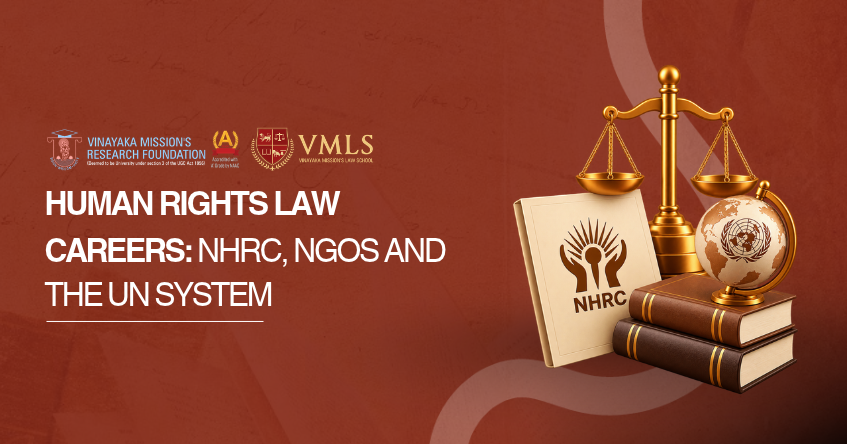
Some students choose law because they want to change how institutions treat people. Human rights law gives that goal a professional shape, with careers in government commissions, non-profit organisations, courts and international bodies. The work is demanding and rarely the best paid, but it offers direct impact on people whose rights are at risk.
This guide describes the main employers, the skills they want and the law courses in India that prepare you for them.
Key Takeaways
- Human rights law spans constitutional rights, international conventions and everyday access to justice.
- The National Human Rights Commission and State Commissions investigate and recommend remedies for violations.
- NGOs and public interest litigation offer direct advocacy work.
- UN agencies and international organisations recruit law graduates for research and programme roles.
- Clinical experience is often the strongest credential for entry.
What Human Rights Law Covers
In India, human rights work draws on the Fundamental Rights in the Constitution, statutes such as the Protection of Human Rights Act, 1993, and international treaties the country has joined. Subjects include custodial violence, discrimination, labour rights, gender justice, rights of children and persons with disabilities, and refugee and migrant protection. A reading of the Supreme Court Handbook on Gender Explained shows how courts frame these questions.
Working With the NHRC and State Commissions
The NHRC, established under the 1993 Act, inquires into complaints of human rights violations, visits detention facilities and recommends action to authorities. State Human Rights Commissions do similar work within states. Graduates join as legal researchers, investigators or consultants, and some move later into advisory or policy roles. Applicants who can write precise reports and understand procedure are valued.
NGOs and Public Interest Litigation
Non-governmental organisations run legal aid, strategic litigation and community education. Public interest litigation under Articles 32 and 226 allows courts to hear matters on behalf of those who cannot approach them directly. The CPIL at VMLS reflects this public interest tradition. Practical examples of field work appear in Empowering Migrant Labourers in Chennai.
The United Nations and International Bodies
The UN system includes human rights offices, refugee and development agencies, and special procedures. Entry routes include internships, junior professional programmes and research posts with partner organisations. Competition is strong, so build a record of research, languages and fieldwork. A postgraduate qualification such as an LLM law degree in international or human rights law is a common step.
Courses That Lead Here
Many students take a five-year BA LLB, while graduates choose the three-year LLB. Review the LLB admission eligibility and exam details before applying, and ask about Scholarships if funding is a concern. When comparing the best law university in India for human rights, look for clinical programmes, faculty research and links to practising organisations.
Building Experience
Take part in legal aid camps, volunteer with local NGOs and follow reported rights cases closely. Clinical programmes give structured experience, as described in Future Human Rights Advocates and Clinical Legal Education and Clinical Legal Education: Justice for the Marginalized. At VMLS this work is organised through the Centre for Access to Justice.
Questions about the course or funding? Our team can help you plan. Contact Us →
Frequently Asked Questions
Not for many NGO and commission roles, but international organisations often prefer a postgraduate degree.
Entry roles such as research associate or intern are possible, and requirements vary by vacancy, so check current notices.
No. Research, policy, documentation, training and advocacy all offer careers.
Related Reads
- Future Human Rights Advocates and Clinical Legal Education. Learn by practice.
- Clinical Legal Education: Justice for the Marginalized. Serving communities.
- Empowering Migrant Labourers in Chennai. A field example.
- Supreme Court Handbook on Gender Explained. Judicial framing of rights.
- Scholarships. Funding options.