- Quick Answer
- What does the Constitution say about the language of the courts?
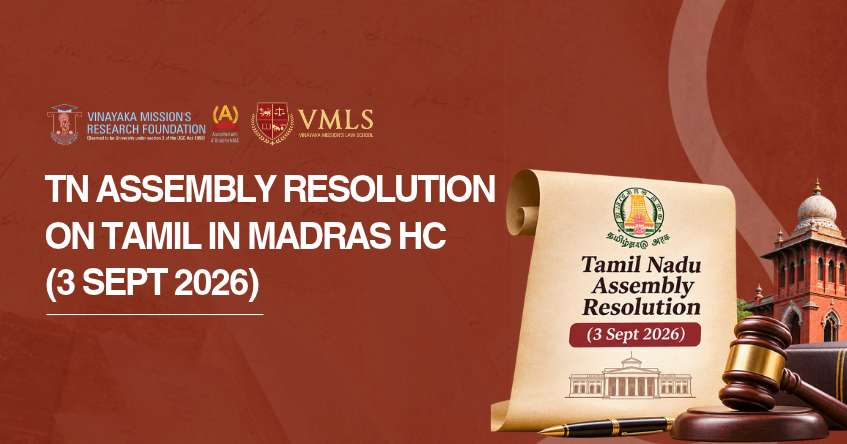
- What did the Tamil Nadu Assembly resolve on 3 September 2026?
- What are the main arguments in the wider debate?
- Why does this matter to a law student?
- How can you build bilingual legal skills?
- How does VMLS support bilingual legal education?
- Sources and further reading
- Frequently Asked Questions
Quick Answer
Under Article 348(1)(a) of the Constitution, all proceedings in the Supreme Court and every High Court are conducted in English, so the Tamil Nadu Legislative Assembly's unanimous resolution of 3 September 2026 can take effect only if the Union Government acts, through the President's consent under Article 348(2) or Section 7 of the Official Languages Act, 1963.
This explainer describes the legal route and the positions taken. It does not take a side on the policy question.
What does the Constitution say about the language of the courts?
- Article 348(1)(a): all proceedings in the Supreme Court and every High Court are in English.
- Article 348(2): a Governor, with the President's prior consent, may authorise Hindi or another language used for official purposes of the State in proceedings of the High Court. This route is read as covering proceedings rather than judgments, decrees and orders.
- Section 7, Official Languages Act, 1963: with the President's prior consent, a State's official language may be used alongside English in High Court judgments, decrees and orders, with an English translation.
- Subordinate courts: Tamil already has legal recognition for evidence, judgments, decrees and orders in subordinate courts and tribunals in Tamil Nadu.
What did the Tamil Nadu Assembly resolve on 3 September 2026?
The Assembly unanimously urged the Union Government to take immediate legal and administrative steps so that Tamil can be used as the principal language of the Madras High Court. The resolution seeks:
- procedures for filing petitions and documents and for oral arguments in Tamil;
- judgments, decrees and orders made available in Tamil;
- training in legal Tamil and translation for judges, advocates and court staff.
It points to advances in translation technology, e-courts and legal databases. The Chief Minister said the aim is to give Tamil equal procedural standing, not to replace English. An earlier Assembly resolution on the same subject dates from December 2006. Because Article 348 needs Union-level action, the resolution alone does not change court procedure.
What are the main arguments in the wider debate?
| Points made in favour | Points commonly raised for caution |
|---|---|
| Litigants can follow and take part in their own cases | High Court judgments are appealed to the Supreme Court, where proceedings stay in English and there is no State-specific route |
| Translation tools and legal databases make bilingual records more feasible | Translation quality, cost and training for judges, lawyers and staff |
| Tamil already works in subordinate courts | The constitutional route needs the President's consent and Union action |
| The State earlier earmarked ₹3 crore for translating High Court judgments | A Madras High Court judge has told lawyers seeking Tamil to start by helping translate judgments |
Why does this matter to a law student?
Whatever Parliament and the President decide, bilingual legal skill is becoming more valuable. Opportunities include legal translation and editing, vernacular legal-technology work, access-to-justice clinics, drafting in two languages, and advocacy in district courts where Tamil is already in use. This links directly to the questions in our guide to studying law in a bilingual law school in Chennai.
How can you build bilingual legal skills?
- Keep a two-column glossary of legal terms in English and Tamil and update it weekly.
- Read bare Acts and judgments in both languages where available and compare how terms are rendered.
- Practise client interviews and plain-language explanations in Tamil.
- Join Tamil-language moot or mock-trial rounds.
- Translate one short judgment a month and have it reviewed by a faculty member.
How does VMLS support bilingual legal education?
Vinayaka Mission's Law School (VMLS), Chennai, describes itself as a bilingual law school, with the tagline "Bilingual Excellence | Global Standards | Inclusive Justice", and is mentored by O.P. Jindal Global University. It runs the Global Tamil Law Centre and a Tamil moot court, and works on language access through its Centre for Access to Justice. See also top bilingual law schools in Chennai. The admissions form lists a "Student from Tamil Medium Scholarship" among its scholarship categories (confirm current criteria with the admissions team).
Study law in Tamil and English: apply to VMLS 2027-28 →
Frequently Asked Questions
Article 348(1)(a) requires English in the Supreme Court and High Courts. Article 348(2) lets a Governor, with the President's prior consent, authorise a State language in High Court proceedings.
No. It urges the Union Government to act, and Article 348 requires Union-level steps before Tamil can formally become the principal language.
Yes. Tamil Nadu's official-language provisions recognise Tamil for evidence, judgments, decrees and orders in subordinate courts and tribunals.
Yes. VMLS describes itself as a bilingual law school and runs the Global Tamil Law Centre. See its admissions page for programme details.
Sources and further reading
- SCC Online: Tamil Nadu Assembly seeks Tamil as principal language of Madras High Court
- Outlook India: Assembly unanimously backs Tamil
- All India Radio: Assembly adopts resolution
- Bar & Bench: ₹3 crore for translating judgments into Tamil
Join a bilingual law school: register for admission at VMLS →
This article is educational and is not legal advice.