By Saromitha Kumar, BA.LL.B Student

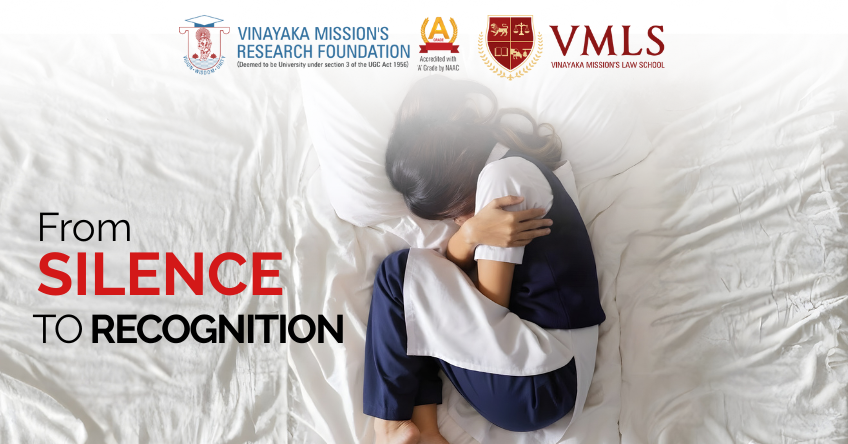
In April 2024, a fourteen-year-old girl in Mumbai died by suicide after experiencing her first menstrual cycle. According to her family, she was overwhelmed by fear and confusion, unable to comprehend the bodily changes she was undergoing, having received no prior information or support. Her death is not an aberration but a stark reminder of how menstrual silence continues to cost lives. It reflects the deeper reality of how stigma, ignorance, and institutional neglect surrounding menstruation persist in India.
This case forces an uncomfortable question: how can something so universal remain so invisibilised — socially, legally, and constitutionally?
India has over 355 million menstruating individuals, yet menstrual health remains a neglected public and legal concern. Only 42% of women in rural India use hygienic menstrual products exclusively. Over 23 million girls drop out of school annually due to menstruation-related barriers such as a lack of toilets, disposal facilities, privacy, or basic information. One in four girls misses school during menstruation, and over 71% are unaware of menstruation before their first period.
The physical burden is severe. Dysmenorrhea affects a majority of adolescents, with a significant proportion experiencing pain intense enough to restrict school or work participation. Poor menstrual hygiene contributes to reproductive health issues and increased infection risks. Cultural practices further intensify harm — menstruating women are excluded from kitchens, temples, public spaces, and social interaction. Silence, shame, and secrecy are normalised.
The cumulative effect is devastating. Menstruation becomes a barrier to health, education, dignity, and participation in society. Yet despite its scale and impact, menstruation has historically remained absent from constitutional discourse.
Legislative Silence and the Cost of Ignoring Biology
For decades, menstruation in India has been addressed only through fragmented schemes and non-binding policies. Government guidelines, subsidised pad schemes, and infrastructure mandates exist, but they lack enforceability and are inconsistently implemented. Parliament has failed to enact comprehensive menstrual rights legislation, leaving menstrual dignity outside the realm of enforceable rights.
As a result, menstruation has been treated as a welfare concern rather than a constitutional one. When menstrual needs are not recognised as rights, denial of hygiene, privacy, accommodation, and information becomes normalised. Structural harm is rendered invisible, making judicial intervention inevitable.
Why Theory Matters: Understanding the Injustice
Feminist legal theory explains this neglect: law has been shaped around male bodies, rendering women’s biological realities invisible. Menstruation is excluded not due to insignificance, but due to an androcentric constitutional interpretation.
Martha Nussbaum’s Capabilities Approach clarifies the harm. Menstrual stigma and lack of access undermine bodily health, dignity, education, emotional well-being, and social participation — pushing individuals below the minimum threshold of a dignified life.
Aristotle’s idea of substantive equality reinforces this point. Treating unequals alike is not justice. Ignoring menstruation under formally neutral laws produces disproportionate disadvantage. Intersectionality further reveals that marginalised menstruators — poor, rural, Dalit, Adivasi, disabled, and adolescent — bear compounded harm.
The Supreme Court’s Intervention: A Constitutional Shift
Against this backdrop, the Supreme Court’s interpretation of Article 21 to include menstrual health and dignity marks a decisive constitutional turn. Reaffirming that the right to life means a life of dignity, privacy, bodily autonomy, and health, the Court located menstruation squarely within constitutional protection.
This recognition reframes menstruation from a private inconvenience or welfare issue into a constitutional concern. It breaks decades of silence, supersedes legislative inaction, and establishes menstrual dignity as a non-negotiable constitutional threshold rather than a matter of state discretion.
Why Recognition Alone Is Not Enough
Judicial recognition, however transformative, cannot operate in isolation. Constitutional rights must translate into lived protection. Without enforceable standards, infrastructure, education, and intersection-sensitive implementation, recognition risks remaining symbolic.
Constitutional recognition must therefore be coupled with:
- minimum national standards for menstrual hygiene and sanitation
- non-discriminatory school and workplace environments
- access to affordable menstrual products and pain-management support
- comprehensive education and awareness initiatives
- accountability mechanisms to enforce constitutional duties
Conclusion
The Constitution cannot remain indifferent to a biological reality that shapes the daily lives of millions. By reading menstrual dignity into Article 21, the Supreme Court has not created a new right — it has corrected a long-standing constitutional omission. In doing so, it has affirmed that dignity, health, and bodily autonomy are not abstract ideals, but lived conditions that the Constitution must actively protect.
This long-overdue recognition is a decisive step in the right direction, affirming that the Constitution must respond to realities that shape the lives of millions. Now, it is imperative for policymakers, educators, and civil society to translate this recognition into tangible protections, infrastructure, and education that safeguard menstrual dignity for all.
References
- Right to Menstrual Health part of Right to Life: SC issues directions on Free Sanitary Pads, Menstrual Hygiene Management corners in schools, SCC Online (Jan. 30, 2026), https://www.scconline.com/blog/post/2026/01/30/right-to-menstrual-health-part-of-art-21-of-constitution/.
- Puja Bhardwaj, Mumbai Girl Dies by Suicide; Family Says She Was Stressed by Her First Period, NDTV (Apr. 15, 2024), https://www.ndtv.com/india-news/mumbai-girl-dies-by-suicide-family-says-was-stressed-by-her-1st-period-5360504.
- Kruti S. Chaliawala & Priyanka Dubey, A Narrative Review of Interventions on Menstrual Health for Adolescent Girls in Rural India, Boston Conglomerate Public Health Review, Vol. Spring 2025, Issue 90 (May 16, 2025).
- Aditya Singh et al., Menstrual Hygiene Management Among Adolescents in India: A Systematic Review, BMC Public Health 22 (2022).
- Dasra, Spot On! Improving Menstrual Health in India (2014).
- UNESCO, Puberty Education and Menstrual Hygiene Management (2014).
- A.K. Agarwal & A. Agarwal, A Study of Dysmenorrhea During Menstruation in Adolescent Girls, Indian Journal of Community Medicine 35(2):159–164 (2010).
- A.M. van Eijk et al., Menstrual Hygiene Management Among Adolescent Girls in India: A Systematic Review and Meta-Analysis, BMJ Open 6(3): e010290 (2016).
- National Family Health Survey–5 (2019–2021), Ministry of Health and Family Welfare, Government of India.
- Martha C. Nussbaum, Women and Human Development: The Capabilities Approach (Cambridge Univ. Press 2000).
- Katharine T. Bartlett & Rosanne Kennedy eds., Feminist Legal Theory: Readings in Law and Gender (Westview Press 1991).
- Kimberlé Crenshaw, Demarginalizing the Intersection of Race and Sex, 1989 U. Chi. Legal Forum 139.