


- What Does Effective Law Prep Actually Involve?
- Build a Realistic Study Plan Around Outputs
- Turn Course Materials into Usable Outlines
- Practice Retrieving Rules Before Checking Notes
- How Should You Practice Legal Analysis Under Time Pressure?
- Make Mistakes Useful with a Short Error Log
- Adjust Bar Exam Prep to Your Actual Examination
- Choose Resources and Feedback with a Clear Purpose
- Rehearse the Conditions and Simplify the Final Stretch
- Keep the Next Step Specific
- Frequently Asked Questions
Effective law prep means preparing to use legal knowledge, not simply collecting it. This article offers a practical approach to planning study time, organizing rules, practicing analysis, and reviewing mistakes for law school exams and bar exam prep. Use it to build a study routine around the work your assessment actually requires.
The aim is not a flawless outline or an uninterrupted study streak. It is a repeatable process: identify what you need to know, attempt a task, examine the result, and make a targeted adjustment.
Key Takeaways
- Effective law prep focuses on applying legal rules to factual scenarios rather than passive memorization.
- Structure study sessions around tangible outputs (recall, check, apply, review) rather than open-ended desk hours.
- Working outlines should serve as decision trees—highlighting factual triggers, elements, and defenses.
- Practice legal analysis using an explicit Issue-Rule-Application-Conclusion framework under real-world time constraints.
- Maintain a short error log to diagnose recurring mistakes and target future practice sessions effectively.
Preparing for Law School Admissions? Explore VMLS Programmes →
What Does Effective Law Prep Actually Involve?
Effective law prep combines understanding legal rules with practicing how to recognize issues, apply those rules to facts, and communicate an answer within the assessment’s constraints. Georgetown Law’s exam guidance connects preparation with usable outlines, practice answers, and review of professor feedback—not just reading course materials.
Start by identifying your destination. A course exam and a professional licensing exam should not automatically receive the same study plan. For a course, gather the syllabus, assessment instructions, available past papers, and instructor guidance. For a licensing exam, consult the relevant examining authority before choosing materials.
Create a brief assessment profile that answers these questions:
- Coverage: Which subjects, skills, and sources are included?
- Format: What kinds of questions or written tasks must you complete?
- Conditions: What timing, reference-material, and technology restrictions apply?
- Feedback: Which rubrics, answer explanations, or sample responses can guide review?
Keep that profile beside your schedule. Before adding another study activity, ask which requirement it serves. If you cannot identify one, reconsider whether it deserves priority.
Build a Realistic Study Plan Around Outputs
Use your calendar to define what you will produce, rather than merely how long you will sit at a desk. “Review contracts” leaves the task open-ended. “Write a rule checklist, complete a practice problem, and review the answer” gives the session a clear finish line.
Begin with a diagnostic attempt before designing an ambitious timetable. Duke’s Academic Resource Center recommends using practice exams throughout studying to assess understanding and identify areas needing attention. Treat your first attempt as information, not a prediction of your eventual result.
A sample study session might include:
- Recall: Write the relevant rules without consulting notes.
- Check: Compare your version with the assigned material and correct omissions.
- Apply: Complete a question that requires those rules.
- Review: Explain the most important error and choose a follow-up task.
Scale that sequence to the time you have. On a busy day, work through one narrow issue rather than abandoning the session entirely. On a longer study day, repeat the sequence with another topic instead of extending passive reading indefinitely.
Leave some calendar space unassigned. Use it for unfinished work, unexpected commitments, or a topic that needs another attempt. Treat the schedule as a planning tool, not a daily verdict on your discipline.
Turn Course Materials into Usable Outlines
An outline should help you organize and apply the material, not become a second casebook. Georgetown Law describes outlining as a personal process and suggests formats such as checklists and flowcharts when they fit the student’s needs. There is no requirement to imitate a classmate’s document.
For your working outline, try organizing each topic around a decision:
- What factual trigger should make me consider this issue?
- What rule or test applies?
- Which elements must I address?
- What exceptions, qualifications, or competing arguments matter?
- What facts would support a different conclusion?
Use cases selectively to illustrate a distinction or explain an important rule. Avoid copying lengthy case summaries into every topic unless your assessment specifically requires that detail.
Then test the outline against a practice problem. Mark every place where you struggle to locate a rule or understand the next analytical step. Revise those points before spending time on cosmetic formatting.
Keep the full working document separate from any condensed checklist you develop. Condense only after deciding what the shorter version needs to help you do.
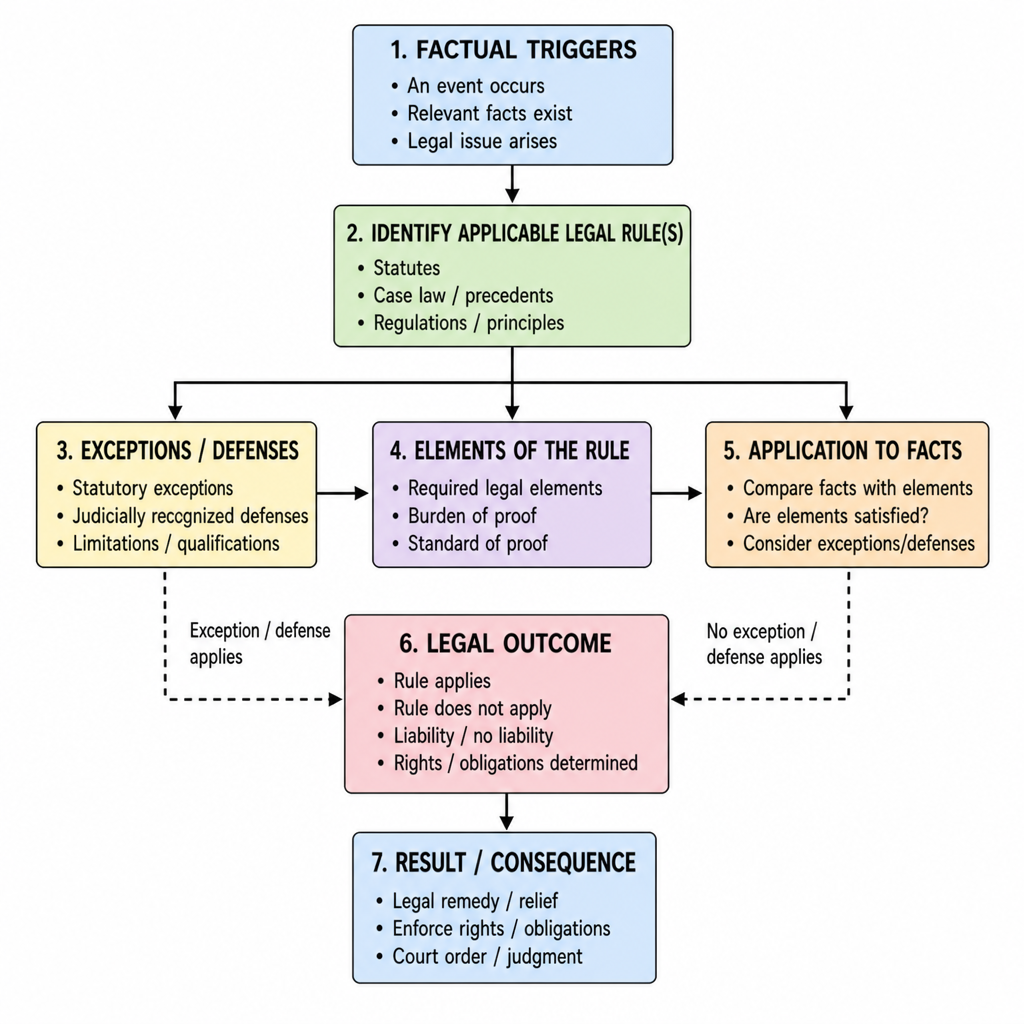
Figure: Decision flowchart for structuring legal analysis from factual triggers to remedies.
Practice Retrieving Rules Before Checking Notes
Make room for attempts that begin without an answer in view. Cornell’s Learning Strategies Center explains that practice testing requires retrieval from memory and can support later recall. Its guidance also recommends matching practice conditions to the resources permitted on the real assessment.
For a manageable exercise, choose one topic and close your materials. State the governing rule, list its elements, and explain an exception aloud or in writing. Then reopen your notes and correct your version. Record the missing distinction rather than copying the entire topic again.
Try prompts that demand explanation:
- “Which fact would change the outcome, and why?”
- “How does this rule differ from the similar rule in the next topic?”
- “What must be established before this exception matters?”
Revisit the prompt in a later session without looking at your corrected answer first. If the same gap remains, change the task: draw a comparison, work through a hypothetical, or ask for clarification. Do not let repeated difficulty become a reason to reread the same paragraph without testing your understanding.
How Should You Practice Legal Analysis Under Time Pressure?
Practice legal analysis by writing complete answers, then comparing your reasoning with the assessment’s guidance or available feedback. The American Bar Association’s student exam advice recommends attempting answers before reading samples, outlining issues before writing, and following the professor’s instructions.
Begin with a narrow problem if a full paper feels premature. Read the task carefully, identify the issues it asks you to address, and sketch an answer before drafting. Introduce timing as a deliberate constraint, not as a substitute for understanding.
Make the Connection Between Rule and Fact Explicit
Use an issue-rule-application-conclusion structure as a drafting scaffold when it suits the assignment. For each issue, state the relevant rule, connect specific facts to its requirements, consider a plausible opposing argument, and give a supported conclusion.
For example, replace “The requirement is satisfied” with a sentence explaining which fact supports satisfaction and why. Where a fact points the other way, address it rather than quietly omitting it. Keep your reasoning tied to the stated facts instead of supplying assumptions that make the answer easier.
Review the Reasoning, Not Just the Outcome
After drafting, compare your response with any authorized feedback. Identify omitted issues, incomplete rules, unsupported conclusions, and unnecessary discussion. Do not rewrite your answer simply to resemble a sample’s wording.
Choose one improvement for the next attempt, such as clearer element-by-element application. That gives you something observable to practice instead of the vague instruction to “write better.”
Build Courtroom & Examination Skills — Explore VMLS Legal Programs →
Make Mistakes Useful with a Short Error Log
Keep an error log as a decision tool, not an archive of disappointing scores. After each practice set, record enough information to choose the next useful task. Include uncertain correct answers as well as incorrect ones; a guessed answer still deserves review.
Try these categories:
| Error pattern | Question to ask | Suggested next task |
|---|---|---|
| Missing rule | What knowledge was absent? | Restate the rule, then apply it to a new problem. |
| Missed issue | Which factual trigger did I overlook? | Compare problems that raise and do not raise the issue. |
| Weak application | Where did I skip the reasoning? | Rewrite the paragraph using specific facts. |
| Misread task | What instruction did I miss? | Restate the requested task before answering another question. |
| Timing difficulty | Where did I spend too long? | Attempt a shorter timed section and review the allocation. |
Write a concrete correction beside each recurring problem. “Review evidence” is too broad; “distinguish these two exceptions and test the distinction” is actionable.
At your next planning session, look for patterns rather than counting entries. Use those patterns to adjust your exam preparation strategies. Give recurring weaknesses a defined task and deadline, while keeping other subjects in rotation.
Adjust Bar Exam Prep to Your Actual Examination
For bar exam prep, confirm your jurisdiction’s requirements and the examination you will take before building a resource list. NCBE provides jurisdiction information and separates its official study aids by examination, including NextGen UBE and legacy bar exam materials. Use the category appropriate to your administration rather than assuming every bar resource covers the same tasks (for students in India preparing for national bar licensing, refer to our comprehensive guide on the All India Bar Examination (AIBE)).
Create a checklist from the applicable official scope and instructions. Beside each requirement, note the material you will use and the practice task that will demonstrate your progress. Leave no assessed task represented only by a lecture or reading assignment.
When evaluating an existing course or study plan, ask:
- Does it match the examination I am registered to take?
- Have I scheduled practice for each relevant question or task type?
- Am I reviewing explanations and written feedback, not only recording completion?
- Have I checked administrative instructions separately from substantive study materials?
Avoid adopting another candidate’s timetable unchanged. Build around your own diagnostic work, available hours, and responsibilities. When circumstances change, revise the plan explicitly rather than accumulating an increasingly unrealistic backlog.
Choose Resources and Feedback with a Clear Purpose
Before adding a law prep tutorial, question bank, or study guide, name the problem you want it to solve. You might need a clearer explanation of a doctrine, more practice applying it, or feedback on written organization. Those are different needs; one resource need not serve them all.
Use this selection checklist:
- Relevance: Does it cover your course or examination rather than a loosely related subject?
- Practice: Will you have to produce an answer before seeing an explanation?
- Review: Can you identify why an answer succeeds or fails?
- Fit: Can you realistically use it alongside your existing materials?
For individual feedback, bring a specific question and a work sample. Instead of asking, “How do I improve?” ask, “Where does this paragraph stop applying the rule and start repeating it?”
If you study with peers, attempt the problem independently before comparing responses. Set an agenda around one task or distinction, and check unresolved disagreements against authoritative course materials. End with a concrete correction each participant can make, rather than a larger pile of shared notes.
Rehearse the Conditions and Simplify the Final Stretch
Reserve practice for the conditions you expect to encounter. Cornell recommends using the actual time limit and permitted resources when taking practice tests. A simulation is therefore an opportunity to test both your preparation and your working setup.
Afterward, review more than the answers. Note whether you navigated permitted materials easily, followed the instructions, and left yourself enough time for each task. Adjust your checklist or pacing plan based on what actually happened.
During the final stretch, use a compact readiness check:
- Confirm the official schedule, location or access arrangements, and identification requirements.
- Review applicable technology instructions and permitted-material rules.
- Prepare required items using the organizer’s current guidance.
- Revisit recurring errors and a small selection of representative tasks.
- Plan a stopping point rather than leaving the entire evening undefined.
If your plan falls behind, choose priorities deliberately. Preserve practice and review instead of trying to finish every available resource. Ask for clarification while there is still time to act on it.
Keep the Next Step Specific
Build your law prep around work you can inspect: a recalled rule, an applied answer, a reviewed mistake, or a revised checklist. Use each attempt to decide what comes next rather than treating completed pages as the only measure of progress.
Start with one assessment requirement and one practice task. Review the result, choose a targeted correction, and schedule another attempt. Keep the process manageable enough to repeat.
Start Your Legal Journey at VMLS — Apply for Admissions Today →
Frequently Asked Questions
Effective law prep combines understanding legal doctrines with regular practice in recognizing issues, applying rules to specific facts, and articulating clear conclusions within exam constraints rather than passive reading.
A usable outline should be structured around decisions and applications: factual triggers, governing rules, required legal elements, recognized exceptions, and counterarguments, tested against real practice problems.
Draft complete written answers using an Issue-Rule-Application-Conclusion (IRAC) structure, tie facts directly to each legal element, address opposing arguments, and evaluate your work against sample solutions or rubrics.
An error log categorizes mistakes—such as missing rules, missed issues, weak factual application, or timing troubles—into actionable patterns so you can assign targeted follow-up tasks before test day.