

- What is the full form of LAW?
- The origin of the word law
- What is a clear law definition?
- Where legal rules come from
- Civil and criminal law serve different purposes
- Legal terms that make the subject easier to understand
- How is the rule of law different from law itself?
- A practical method for understanding unfamiliar legal language
- The key takeaway
- Frequently Asked Questions
LAW has no standard full form when it refers to the legal system: “law” is a word, not an acronym. It describes binding rules and the system through which a community regulates conduct. Understanding its meaning, origins, and related legal terms is more useful than memorizing an invented expansion.
Key Takeaways
- LAW is a standalone word derived from Old Norse and Old English roots, not an acronym requiring expansion.
- A practical definition of law is a recognized, enforceable system of rules that regulates community conduct.
- The primary sources of law encompass constitutions, legislative statutes, administrative regulations, and judicial decisions.
- Civil law resolves disputes between private parties, whereas criminal law addresses public offenses prosecuted by the state.
- The "rule of law" demands accountability, transparency, and fairness in the exercise of governmental power.
Interested in Studying Law? Explore VMLS Law Admissions →
What is the full form of LAW?
There is no generally accepted full form of LAW in its ordinary legal meaning. Writing the word in capital letters does not change its origin or turn each letter into the beginning of another word. Dictionaries treat law as an independent word with established meanings, rather than an abbreviation requiring expansion.
If you are searching for “law full form” for a school assignment or general knowledge exercise, the clearest answer is: Law is not an acronym, so it has no standard full form. Follow that answer with a brief definition if the exercise asks for an explanation. That approach distinguishes what the word means from how an abbreviation works.
A useful habit is to check the surrounding context before expanding capital letters. If a document explicitly defines LAW as a local abbreviation, use that definition within that document. Do not assume that a context-specific label explains the ordinary English word.
The origin of the word law
The word law reached English through older language forms, not through a phrase shortened to three letters. Its history includes Old English lagu and Scandinavian roots associated with things laid down or established. That background helps explain its connection with established rules.
Etymology and definition answer different questions. Etymology explains where a word came from; definition explains what it means in a particular use. Neither should be confused with a memorable phrase created afterward to match its letters. For law, the recorded linguistic history provides the appropriate explanation of its origin.
For study notes, keep the distinction simple: write the word, record its meaning, and add a separate origin note if needed. This prevents a common learning mistake—substituting an easy-to-remember expansion for an accurate explanation.
What is a clear law definition?
A practical law definition is a system of rules that regulates conduct within a community and is recognized or enforced by an authority. Law can also mean a particular rule or an entire body of rules. The intended meaning depends on whether someone is discussing one requirement, a subject area, or the legal system overall.
For example, references to criminal law describe a field of law, while a reference to a particular statute identifies a specific legislative enactment. Saying someone “studies law” uses the word for an academic or professional field. Recognizing these different uses makes legal writing easier to follow without assuming that every appearance of the word means exactly the same thing.
A beginner-friendly way to examine a legal statement is to identify three elements:
- The rule: What conduct does it require, permit, or prohibit?
- The authority: Which legislature, agency, or court supplies the relevant legal authority?
- The consequence: What legal effect or remedy might follow if the rule applies?
Use these as reading prompts, not as a substitute for checking the actual legal source. Legal research involves finding the authority relevant to a particular problem. A summary can orient you, but it is not necessarily the controlling rule.
Where legal rules come from
Law is not limited to rules passed by a legislature. In modern legal systems, legal research can involve constitutions, statutes, regulations, and judicial decisions. Understanding the type of source helps you distinguish a binding legal requirement from commentary explaining it.
Constitutions and statutes
A constitution establishes a government's fundamental legal framework. It can define governmental institutions, allocate powers, and protect rights. Constitutional questions therefore concern more than whether a particular action seems sensible; they can concern whether the government has authority to act at all.
A statute is a law enacted by a legislative body. When researching a statutory requirement, identify the relevant provision rather than relying only on the law's popular name. A legal research tool may help locate the provision, but the statutory text remains the source you need to examine.
Regulations and judicial decisions
Government agencies can issue regulations under authority delegated to them. These rules address matters within an agency's responsibilities and can provide requirements that a broad statute does not spell out in detail. To understand a regulation, it helps to identify both the issuing agency and its legal authority.
Court decisions also matter. A prior decision may serve as precedent when a later case presents relevantly similar facts or legal issues. However, reading one sentence from a judgment is not enough: the issue actually decided and the circumstances of the case affect what that decision establishes.
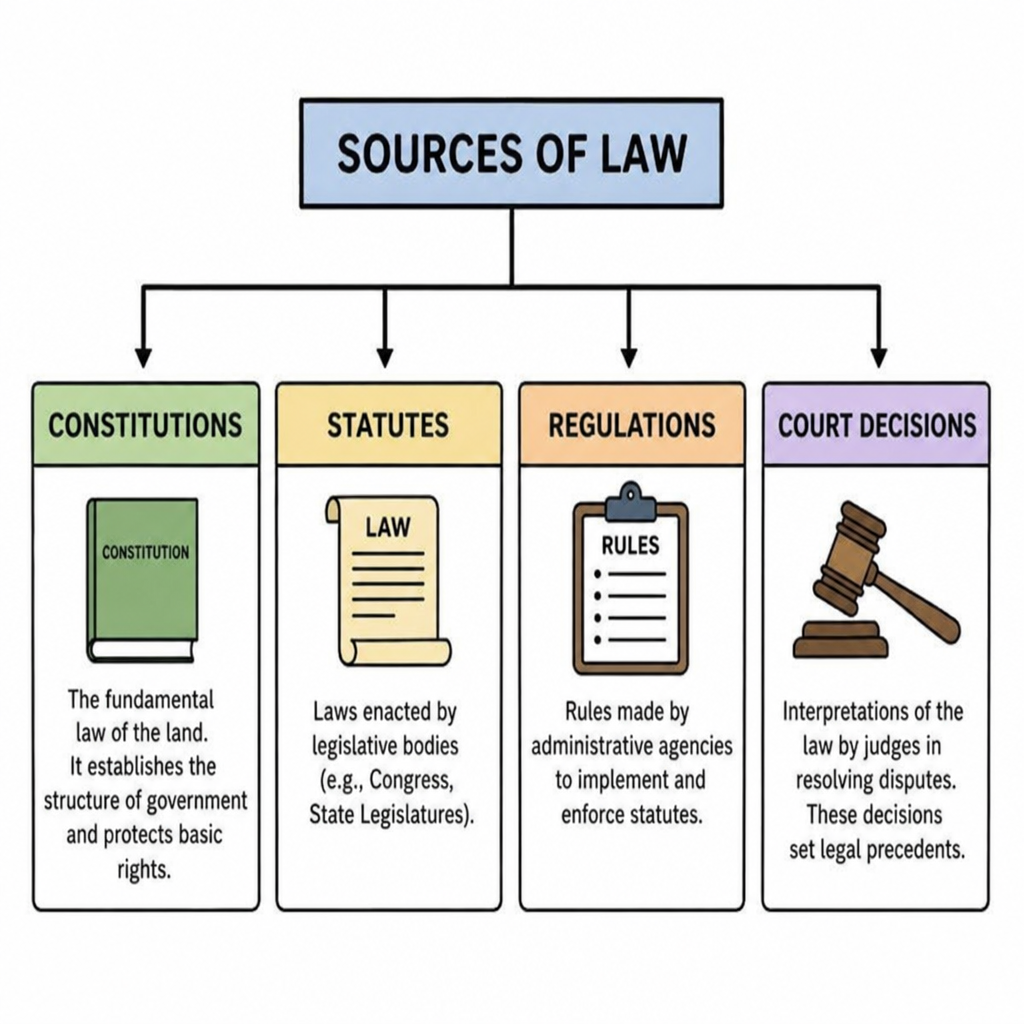
Figure: Core sources of law including constitutional frameworks, enacted statutes, administrative regulations, and judicial precedents.
Civil and criminal law serve different purposes
Civil and criminal cases are important categories, but they should not be treated as interchangeable. In court systems, a civil case generally involves a legal dispute between parties, while a criminal case involves a prosecution brought by the government. Their procedures, purposes, and possible outcomes differ.
In a civil case, a party may seek money or another remedy, such as an order requiring someone to act or stop acting. A disagreement about a contractual obligation is one example of the kind of dispute that can produce civil litigation. Seeking a remedy is different from asking the government to punish a crime.
In a criminal trial, the prosecution must prove the defendant's guilt beyond a reasonable doubt. The defendant does not have to prove innocence. This burden is an essential distinction to retain when reading reports about accusations, prosecutions, and verdicts.
For beginners, the practical lesson is to identify the type of proceeding before interpreting its vocabulary. Ask who brought the case, what they must establish, and what outcome they seek. Those questions offer a stronger starting point than assuming every court dispute follows the same process.
Legal terms that make the subject easier to understand
Learning a few fundamental legal terms gives you a useful foundation for reading court information and introductory legal materials. The following explanations reflect common court usage; they are starting points rather than complete accounts of every possible application.
| Legal term | Plain-language meaning |
|---|---|
| Plaintiff | The party who brings a civil lawsuit. |
| Defendant | A party sued in a civil case or accused in a criminal case. |
| Jurisdiction | A court's legal authority to hear and decide a case; the term can also refer to a geographical area. |
| Evidence | Information presented to help establish facts in a proceeding. |
| Judgment | A court's decision resolving the parties' rights or obligations. |
| Appeal | A request for a higher court to review a lower court's decision. |
| Injunction | A court order requiring someone to do something or refrain from doing something. |
| Damages | Money awarded as compensation for a legally recognized injury or loss. |
In particular, an appeal concerns review of a lower court's decision, rather than simply expressing disagreement with the result.
When learning a new term, write a short example beside it. For “injunction,” you might picture an order directing a party to stop specified conduct. For “damages,” picture a request for monetary compensation. Keep the examples clearly hypothetical so they help you remember the distinction without implying a guaranteed legal outcome.
Build Your Foundation in Legal Studies — Apply to VMLS Today →
How is the rule of law different from law itself?
Law refers to legal rules and systems; the rule of law concerns the principles under which legal authority should operate. The United Nations describes it through accountability, publicly available laws, equal enforcement, independent adjudication, and consistency with international human rights standards. Government itself must also be accountable under the law.
This distinction matters because the existence of rules alone does not establish that power is exercised fairly. The rule-of-law framework also asks how laws are applied, whether decisions are arbitrary, and whether institutions operate transparently. It connects legal authority with limits and safeguards, rather than treating authority as unlimited.
For a beginner, this provides a useful reading lens. When a discussion shifts from what a rule says to whether officials apply it fairly or independently, the subject may be the rule of law. Keeping those ideas separate makes discussions about government and justice more precise.
A practical method for understanding unfamiliar legal language
You do not need to memorize a dictionary before beginning. Start with the issue you are trying to understand, then identify the vocabulary and sources that matter to it. Legal research distinguishes primary authorities, such as statutes and court decisions, from secondary materials that explain or discuss the law.
Use this checklist when reading an unfamiliar legal passage:
- Identify the context: Note the country, state, court, or institution involved before looking up individual words.
- Separate facts from conclusions: Mark what the passage says happened and what legal result it claims follows.
- Find the source: Look for a statute number, regulation, court decision, or official document supporting the statement.
- Read surrounding text: Do not stop at a search snippet or an isolated sentence; inspect definitions, exceptions, and scope.
- Check relevance and timing: Ask whether the material addresses your location and situation, and whether you need a more current source.
- Record unresolved questions: Write down what remains unclear instead of filling the gaps with assumptions.
For example, imagine reading that a business “must provide notice.” Before deciding what that means, identify who must receive notice, what information it must contain, and which source creates the requirement. Treat each missing detail as a research question, not an invitation to guess.
If you are studying, turn the passage into a short explanation in your own words. Then compare that explanation against the original. If your version loses an exception or changes “may” into “must,” revise it before using it in your notes.
For a real dispute, use introductory explanations to prepare better questions rather than to predict the outcome. This article provides general education, not advice about a particular legal problem. Seek qualified legal assistance when you need guidance tailored to your circumstances.
The key takeaway
The answer to “law full form” is straightforward: law is an ordinary word, not a standard acronym. Its meaning and history—not a letter-by-letter expansion—provide the reliable starting point.
Build from there by learning the main sources of law, distinguishing civil and criminal proceedings, and using legal vocabulary carefully. Above all, develop the habit of asking where a legal claim comes from and whether it applies to the situation you are examining.
Start Your Journey in Law — Explore Undergraduate & Postgraduate Degrees at VMLS →
Frequently Asked Questions
Law is an independent word derived from Old English (lagu) and Scandinavian roots, not an acronym. Therefore, it has no standard or official full form.
Writing LAW in capital letters is typically a stylistic choice in headings, titles, or search queries, but it does not make the English word an abbreviation or acronym.
Primary sources of law include constitutions, legislative statutes, administrative regulations, and judicial decisions (case law precedents).
While law refers to specific rules and statutes, the rule of law refers to the governance principle that all persons and institutions are accountable to publicly promulgated, equally enforced laws.