
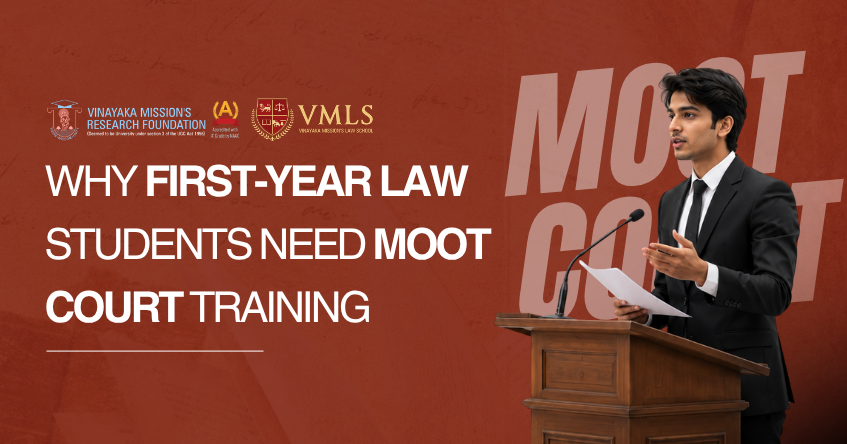
Reading a judgment and arguing one in front of a bench are two very different skills — and moot court is where every law student learns the difference. For a first-year law student, a moot court competition is often the first real exposure to how legal argument, procedure, and advocacy actually come together, making it one of the most valuable forms of practical legal training in a law degree.
Key Takeaways
- A moot court is a simulated court proceeding where students argue a hypothetical case before judges, replicating real courtroom procedure.
- Moot court competitions build research, drafting, and oral advocacy skills that classroom learning alone cannot provide.
- First-year law students benefit most from starting early, when the learning curve is steepest and the pressure is lowest.
- Regular moot court participation strengthens a student's application for internships, judicial clerkships, and litigation careers.
- VMLS builds moot court training into its curriculum through dedicated facilities and structured competitions.
Preparing for a Law Entrance Exam or LLB? Explore VMLS Admissions →
What Is a Moot Court and Why Does It Matter?
A moot court is a simulated legal proceeding in which students argue both sides of a hypothetical case before a panel of judges — usually faculty, practising lawyers, or sitting judges — following the same procedural conventions used in a real courtroom. Unlike a classroom discussion, moot court demands a complete legal exercise: researching the law, drafting written submissions (memorials), anticipating counter-arguments, and then defending a position live, under questioning.
Our detailed explainer on what a moot court actually is breaks down the structure and stages of a typical competition for students encountering the format for the first time.
How Moot Court Competitions Build Practical Legal Training
Moot court competitions compress several core lawyering skills into a single exercise:
- Legal research — locating and applying statutes, case law, and precedent to an unfamiliar fact pattern.
- Written advocacy — drafting a memorial that presents a legal argument clearly, persuasively, and within strict formatting rules.
- Oral advocacy — presenting arguments confidently, structuring them logically, and responding to a judge's questions in real time.
- Time and pressure management — a skill classroom exams rarely test, but litigation regularly demands.
This is precisely why moot court is treated as core, not optional, in most well-regarded law schools — a point explored further in our piece on why moot court matters in law school.
What First-Year Law Students Gain from Moot Court
For a first-year student, early moot court exposure offers benefits well beyond the competition itself:
- A practical anchor for theory — abstract concepts from Contracts, Torts, or Constitutional Law become concrete once applied to a real fact pattern.
- Confidence in public speaking — most students find their first moot round intimidating; by the third or fourth, courtroom nerves are far more manageable.
- Early exposure to procedure — understanding how pleadings, submissions, and court etiquette actually work, well before an internship demands it.
- A stronger CV early — moot court participation and awards are among the first substantive achievements a first-year student can point to when applying for internships, as outlined in our year-by-year guide to law school internships.
Inside VMLS Moot Court: Facilities and Culture
VMLS maintains a dedicated, state-of-the-art Moot Court facility designed to simulate real courtroom proceedings, giving students a practical environment to build advocacy skills well before they step into an actual court. Beyond infrastructure, VMLS runs structured intra-college and national-level moot court competitions throughout the academic year, supported by faculty trained in criminal, constitutional, and commercial law — a culture that ties directly into programmes such as the LL.M. in Criminal Law and Practice at VMLS and the broader Criminal Law programme in Chennai, where moot problems are often drawn from live legal issues.
How to Prepare for Your First Moot Court Competition
- Read the moot problem multiple times before researching — missing a key fact early can derail an entire argument.
- Start research broad, then narrow — begin with the relevant statute or code, then move to case law that interprets it.
- Draft the memorial in stages — issues, arguments, and prayer for relief — rather than attempting it in one sitting.
- Practise oral rounds out loud, ideally in front of peers or faculty who can ask unscripted questions.
- Watch senior students moot before your first competition to understand pacing, tone, and how judges typically intervene.
Build Your Legal Career on a Strong Foundation — Apply to VMLS Today →
Frequently Asked Questions
A simulated court proceeding where law students argue a hypothetical case before judges, following real courtroom procedure.
It builds research, drafting, and oral advocacy skills early, while making classroom theory concrete through practical application.
Yes. Moot court participation and awards are often among the first substantive achievements first-year students can list on internship applications.
Public speaking, time management, structured argumentation, and the ability to think on one's feet under questioning.
Yes, VMLS has a state-of-the-art Moot Court facility along with regular intra-college and national-level competitions.