

- What Is the Uniform Civil Code?
- What Is the Constitutional Basis: Article 44?
- What Does Uttarakhand's UCC Actually Contain?
- What Are the Key Provisions of the Uttarakhand Code?
- What Are the Arguments For and Against a National UCC?
- What Comes Next for Other States?
- Why Does the UCC Matter for Law Students?
- Frequently Asked Questions
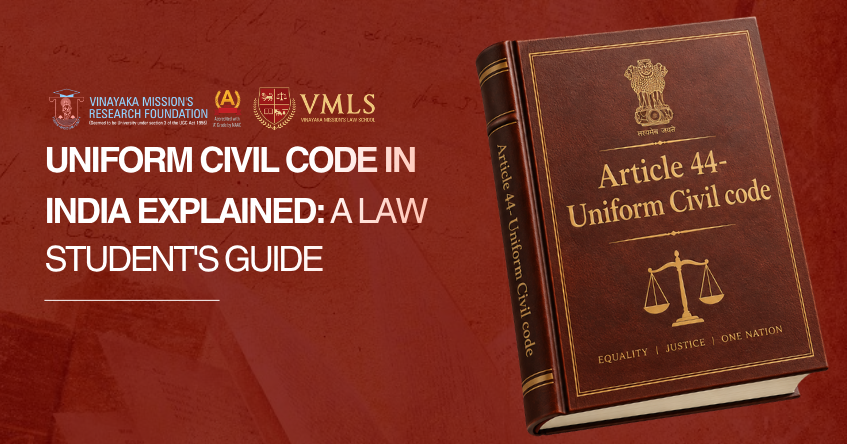
The Uniform Civil Code (UCC) is a proposed common set of personal laws — governing marriage, divorce, inheritance, and adoption — that would apply to all Indian citizens regardless of religion, and on 27 January 2025, Uttarakhand became the first Indian state to actually implement one.
Few topics combine constitutional theory, personal law, and live political debate as directly as the UCC — making it essential reading for any student of Indian constitutional law.
Key Takeaways
- Uttarakhand became the first Indian state to implement a Uniform Civil Code, on 27 January 2025.
- Article 44 of the Constitution is a Directive Principle, not judicially enforceable on its own.
- The Uttarakhand code bans bigamy, polygamy, triple talaq, nikah halala, and iddat, and mandates marriage and live-in relationship registration.
- Scheduled Tribe populations are exempted from the Uttarakhand UCC.
- Supporters cite gender equality; critics raise concerns about religious freedom under Article 25.
What Is the Uniform Civil Code?
A Uniform Civil Code replaces religion-specific personal laws — such as Hindu, Muslim, or Christian laws on marriage and succession — with one common code applicable to every citizen. India currently follows a system where personal laws vary by religious community, while criminal law and most commercial law are already uniform nationwide. Discover how corporate law practice operates alongside personal law systems.
What Is the Constitutional Basis: Article 44?
Article 44 of the Constitution, a Directive Principle of State Policy, states that the State shall endeavour to secure a Uniform Civil Code for citizens throughout India. As a Directive Principle, it is not judicially enforceable, but it has repeatedly been invoked by courts, including the Supreme Court, urging the government toward implementation — most famously in the Shah Bano case and subsequent judgments. Read about landmark rulings in our breakdown of the SC handbook on gender judgments.
Preparing for a Law Entrance Exam or LLB? Explore VMLS Admissions →
What Does Uttarakhand's UCC Actually Contain?
Uttarakhand's Uniform Civil Code was drafted by a five-member committee chaired by retired Supreme Court judge Justice Ranjana Prakash Desai, following consultation with over 230,000 residents. The Assembly passed the Bill in February 2024, the Governor gave assent shortly after, and President Droupadi Murmu approved it in March 2024. After the Cabinet approved implementing rules in January 2025, Uttarakhand formally implemented the UCC on 27 January 2025, becoming the first state in independent India to do so. Notably, the Uttarakhand UCC exempts Scheduled Tribe populations. Explore constitutional rights jurisprudence further in menstrual dignity as a constitutional right.
What Are the Key Provisions of the Uttarakhand Code?
- Marriage age — set at 21 for men and 18 for women, with compulsory registration, as detailed in our law entrance exam current affairs notes.
- Live-in relationships — must be registered, with penalties for non-compliance.
- Bans — bigamy, polygamy, triple talaq, nikah halala, and iddat.
- Inheritance — equal rights for women, and legitimacy plus equal succession rights for children of live-in couples.
- Guardianship — mothers hold guardian status alongside fathers; custody of children under five generally goes to the mother.
What Are the Arguments For and Against a National UCC?
Supporters argue a UCC advances gender equality by removing discriminatory provisions found in some personal laws, particularly around inheritance, divorce, and polygamy, and fulfils the constitutional vision in Article 44. Critics, including several religious and community organisations, argue it risks infringing on religious freedom under Article 25, may not adequately reflect India's diversity of personal law traditions, and raise concerns about implementation without wider consensus-building. This is a genuine contest between constitutional values — equality under Article 14 versus religious freedom under Article 25 — rather than a settled question. For more on institutional reforms, read our analysis of the Tribunals Reforms Bill 2026.
What Comes Next for Other States?
Several other state governments have signalled interest in following Uttarakhand's approach, and its implementation is widely viewed as a potential precedent. Whether a genuinely national UCC follows will likely depend on political consensus-building and possibly future litigation testing the code's provisions against fundamental rights. See how statutory shifts impact legal education in what BCI approval means for a law college.
Why Does the UCC Matter for Law Students?
The UCC debate is a recurring feature of moot court problems, CLAT and VLAT general knowledge sections, and constitutional law viva questions. Understanding both the Uttarakhand code's actual text and the broader Article 44 debate — rather than only the headlines — gives students a genuine edge in entrance exam preparation and constitutional law coursework generally. Hone your courtroom skills with our guide on moot court in law school.
Build Your Legal Career on a Strong Foundation — Apply to VMLS Today →
Frequently Asked Questions
Uttarakhand, which implemented its Uniform Civil Code on 27 January 2025, becoming the first state in independent India to do so. Explore further postgraduate specialisations in our LL.M. in Corporate and Financial Laws overview.
No. Article 44 is a Directive Principle of State Policy, meaning it guides government policy but is not judicially enforceable on its own.
It applies broadly to residents of Uttarakhand but exempts Scheduled Tribe populations from its provisions.
It sets minimum marriage ages (21 for men, 18 for women), makes registration of marriages and live-in relationships mandatory, and bans bigamy, polygamy, triple talaq, nikah halala, and iddat.