
- Quick Answer
- What is the India–UK CETA, and when did it start?
- Which other trade agreements is India implementing?
- What legal work do trade agreements create?
- How should a lawyer analyse an FTA?
- Who hires international trade lawyers?
- How can a student start an international trade law career?
- Sources and further reading
- Frequently Asked Questions
Quick Answer
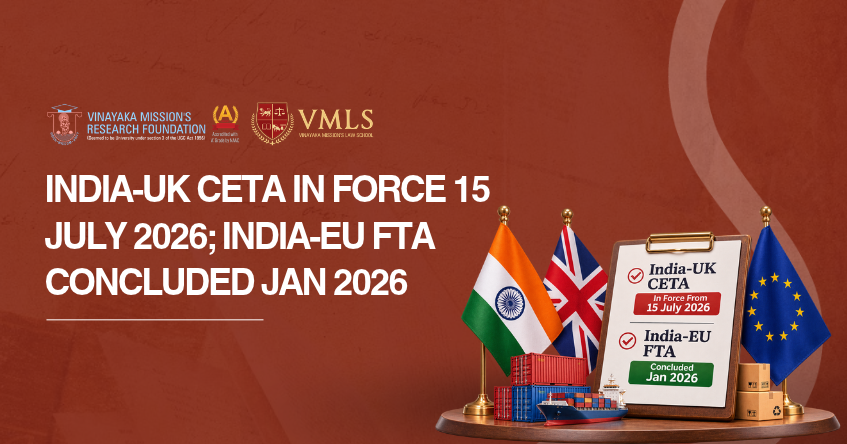
The India–UK Comprehensive Economic and Trade Agreement (CETA) entered into force on 15 July 2026, and together with India's other recent trade deals it is creating demand for lawyers who understand rules of origin, customs, trade remedies and cross-border dispute resolution.
What is the India–UK CETA, and when did it start?
India and the UK signed the CETA on 24 July 2025, and it entered into force on 15 July 2026, later than the originally expected May 2026 after India raised concerns about the UK's new steel safeguard measures. A companion Double Contribution Convention on social security came into force the same day. India gets duty-free access for 99% of its exports to the UK by value, while India reduces tariffs on 90% of its tariff lines, covering 92% of UK goods exports.
Which other trade agreements is India implementing?
| Agreement | Status (verify before citing) |
|---|---|
| India–EFTA TEPA (Switzerland, Norway, Iceland, Liechtenstein) | In force since 1 October 2025 |
| India–UK CETA | In force since 15 July 2026 |
| India–EU FTA | Negotiations concluded on 27 January 2026; signature, EU approval and Indian ratification are still needed |
| India–Oman and India–New Zealand | Concluded in FY2025-26 |
What legal work do trade agreements create?
- Rules of origin and certification: deciding whether goods qualify for preferential tariffs.
- Customs classification and valuation: disputes over tariff lines and duty.
- Trade remedies: anti-dumping and safeguard measures. The UK steel safeguard episode shows how a domestic measure can delay a treaty's start.
- Intellectual property and services chapters: see this IP framework analysis of the CETA.
- Mobility and social security coordination under the Double Contribution Convention.
- Investment protection: talks on a bilateral investment treaty with the UK were reported on hold in April 2026.
How should a lawyer analyse an FTA?
Our reading: a three-layer test.
| Layer | Question | Example |
|---|---|---|
| 1. Treaty text | What did the parties promise? | Tariff schedules, origin rules, services chapters |
| 2. Domestic implementation | How is it applied at the border? | Customs notifications, certificates of origin, tariff-rate quotas |
| 3. Dispute forum | Who decides when it goes wrong? | Customs tribunals and High Courts, treaty consultations, arbitration |
Clients rarely lose at layer one. They lose at layers two and three.
Who hires international trade lawyers?
Law firms with trade and customs practices; in-house teams at exporters and importers; customs and logistics advisers; government bodies such as the Commerce Ministry and the trade remedies authority; think-tanks; and international organisations.
How can a student start an international trade law career?
- Study public international law, WTO law and customs law.
- Join international law moots and research competitions.
- Intern with trade, customs or shipping practices (see our year-by-year internship guide).
- Build data comfort: tariff schedules and origin rules are spreadsheet-heavy.
- Seek global exposure through exchange and partnership programmes (why it matters).
Vinayaka Mission's Law School (VMLS), Chennai, is mentored by O.P. Jindal Global University, an Institution of Eminence, and Jindal Global Law School. It runs the Centre for the Promotion of International Law (CPIL) and signed an MoU with the University of San Diego in January 2026. For shipping's trade link, read maritime law in India after the 2025 reforms.
Learn law with global standards: apply to VMLS 2027-28 →
Frequently Asked Questions
On 15 July 2026, together with a companion Double Contribution Convention on social security.
No. Negotiations concluded on 27 January 2026, but signature, EU approval and Indian ratification are still needed. Check official updates.
India follows a dualist approach: treaty commitments generally need domestic legislation or notifications to take effect, so lawyers track both layers.
Knowledge of customs law, WTO rules and contract drafting, plus comfort with tariff schedules, data and cross-border documentation.
Sources and further reading
- Invest India: India's FTA guide
- HLC: UK and India FTA enters into force
- Ministry of Commerce: CETA to enter into force on 15 July 2026
- CMS: EU–India FTA, the next big trade shift
- PIB: India's trade agreements overview, Feb 2026
Take the first step toward a global legal career: apply at VMLS →
This article is educational and is not legal advice.