
Quick Answer
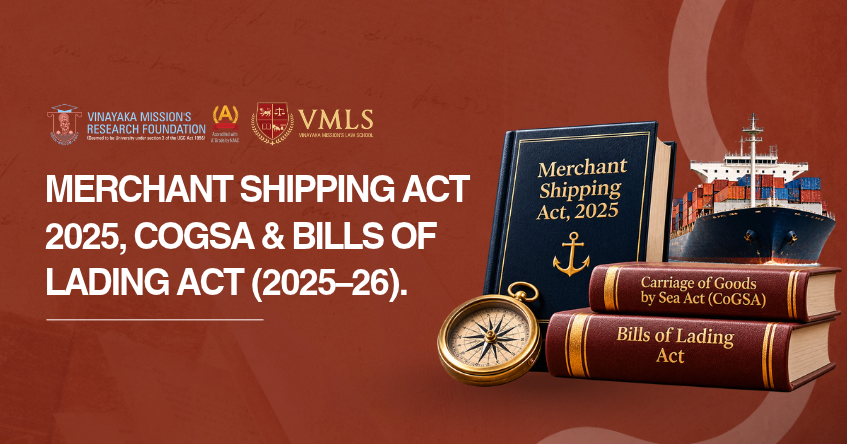
India has replaced older shipping statutes, including the Merchant Shipping Act, 1958 and the Carriage of Goods by Sea Act, 1925, with the Merchant Shipping Act, 2025, the Carriage of Goods by Sea Act, 2025 and the Bills of Lading Act, 2025, creating fresh demand for lawyers in shipping, trade finance and admiralty disputes.
What are India's new maritime laws?
| Law | In force | What it does |
|---|---|---|
| Carriage of Goods by Sea Act, 2025 | 10 Sep 2025 | Replaces the 1925 Act; adopts the Hague-Visby Rules; sets carrier responsibilities, liabilities and immunities |
| Bills of Lading Act, 2025 | 10 Sep 2025 | Modernises shipping documentation, including legal recognition of electronic bills of lading |
| Merchant Shipping Act, 2025 | 15 Mar 2026 | Replaces the 1958 Act; covers vessel registration, ownership, liability and dispute resolution |
| Coastal Shipping Act, 2025 | Check the notification | Builds a national coastal and inland shipping plan and database |
The new Merchant Shipping Act is also a shorter text: the Bill had 325 clauses in 16 parts, compared with 561 sections in the 1958 Act. The Carriage of Goods by Sea Act, 2025 also promotes electronic bills of lading to cut paperwork.
Why do electronic bills of lading matter?
A bill of lading is a receipt for goods, evidence of the contract of carriage and a document of title. Giving electronic versions legal recognition lets cargo move on paperless trade, which can speed up release of goods and reduce fraud and delay. It also raises new questions about platform reliability, control of the electronic record and proof in court, which links directly to our guide to electronic evidence under the Bharatiya Sakshya Adhiniyam.
Our reading: five questions a shipping lawyer now asks.
- Who is the carrier on this bill of lading?
- Do the Hague-Visby limits and immunities apply to this cargo?
- Was the electronic bill issued on a reliable system?
- Who holds control of the electronic record, and how can that be proved?
- Which forum or seat resolves the dispute?
Which courts hear maritime claims, and why does Chennai matter?
Maritime claims such as the arrest of a vessel are heard by High Courts that exercise admiralty jurisdiction under the Admiralty (Jurisdiction and Settlement of Maritime Claims) Act, 2017, and the Madras High Court is one of them. With the Chennai and Kamarajar (Ennore) ports on the coast, Chennai generates its own cargo, charter and ship-arrest work rather than only sending it to other port cities.
What careers does maritime law offer?
| Role | What the work looks like |
|---|---|
| Shipping and admiralty litigator | Ship arrests, cargo claims, collisions |
| Marine insurance and P&I counsel | Coverage and liability disputes |
| Trade-finance and commodity lawyer | Bills of lading, letters of credit, sale contracts |
| Port, logistics and regulatory counsel | Port operations, customs and licensing |
| Ship finance and registration lawyer | Mortgages, registration, ownership |
| Maritime arbitrator or counsel | Charterparty and shipbuilding disputes |
Employers include law firms in port cities, shipping lines, P&I correspondents and commodity traders. Disputes often end in arbitration, so see our guide to arbitration and mediation careers and the trade-law link in India-UK CETA and international trade law careers.
How does VMLS support maritime learning?
Vinayaka Mission's Law School (VMLS), Chennai, lists Maritime Law among its centres of excellence. It is mentored by O.P. Jindal Global University and Jindal Global Law School, and it has signed an MoU with the University of San Diego to widen global exposure. For the dispute-resolution side, see the LL.M. in Commercial Dispute Resolution.
Study law in a port city: apply to VMLS 2027-28 →
Frequently Asked Questions
The Merchant Shipping Act, 2025, which came into force on 15 March 2026.
Yes. The Bills of Lading Act, 2025 and the Carriage of Goods by Sea Act, 2025, both in force since 10 September 2025, recognise electronic bills of lading.
The Carriage of Goods by Sea Act, 2025 adopts the Hague-Visby Rules.
Yes. VMLS lists Maritime Law among its centres of excellence and offers LL.B. (Hons.), integrated five-year law programmes and an LL.M.
Sources and further reading
- India Code: Carriage of Goods by Sea Act, 2025
- SCC Online: Carriage of Goods by Sea Act, 2025 issued
- Mondaq: dispute resolution under the Merchant Shipping Act, 2025
- Ministry of Ports, Shipping and Waterways: Acts and Rules
Start your maritime and commercial law journey: apply at VMLS →
This article is educational and is not legal advice.