
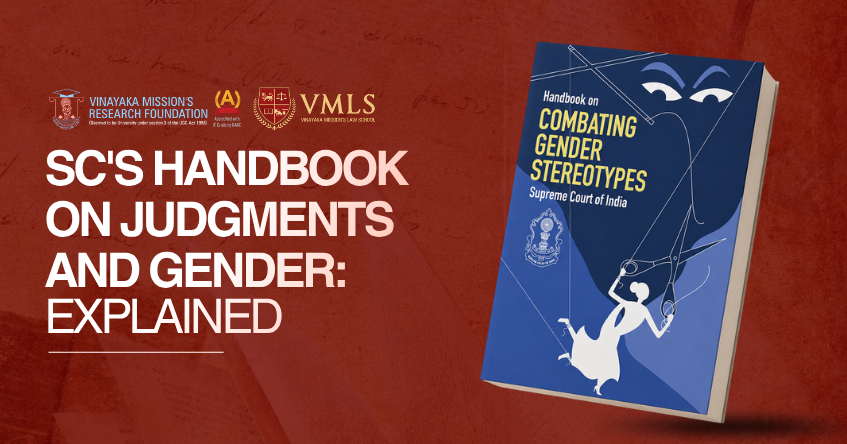
SC's Handbook on Judgments and Gender: Explained
- What Does the Handbook Actually Address?
- Why Does Judicial Language Matter Beyond the Courtroom?
- What Other Rulings Came Alongside the Handbook?
- How Does This Connect to Legal Writing Skills for Students?
- Why Should Judiciary Aspirants Pay Close Attention to This?
- How Should Aspirants Fold This Into Current-Affairs Revision?
- How Are Law Schools Expected to Respond to This Shift?
- Frequently Asked Questions
- Related Reads
The Supreme Court's Handbook on Judgments and Gender urges judges to write with greater gender sensitivity and compassion, addressing how language and reasoning in judicial writing can itself reinforce or challenge stereotypes. Released alongside a week of significant rulings — including clarifications on Section 498-A IPC in live-in relationships and compassionate appointment rights for married daughters — it signals a broader institutional shift in how Indian courts approach gender.
For anyone building toward a legal writing or judiciary career, this is a rare direct look at how the Supreme Court itself thinks about the craft of judgment-writing.
Key Takeaways
- The Handbook on Judgments and Gender pushes judges to avoid outdated terminology and stereotyped assumptions in judicial writing.
- It was released alongside rulings on Section 498-A IPC in live-in relationships and compassionate appointment rights for married daughters.
- It functions as institutional guidance rather than a binding statute, but carries significant weight coming directly from the Supreme Court.
- Judgment-writing ability is directly assessed in judiciary exams, making this a practical topic for aspirants, not just an academic one.
- Law schools shape gender-sensitive practice well before graduation, through clinical legal education programmes in family law and human rights.
What Does the Handbook Actually Address?
The Handbook focuses on the language and framing judges use when writing judgments involving gender — pushing back against outdated terminology, stereotypical assumptions about victims or survivors, and phrasing that can subtly undermine the substance of a ruling even when the legal outcome itself is sound. It treats judicial writing as something that shapes public understanding of the law, not just a technical record of a decision.
Why Does Judicial Language Matter Beyond the Courtroom?
- It shapes precedent — the reasoning and phrasing in a judgment influences how future courts read and apply it
- It shapes public trust — judgments are often the public's most direct encounter with how the justice system reasons about gender
- It shapes legal education — case law with outdated or stereotyped language has long been a quiet feature of legal training, and this Handbook explicitly pushes against that pattern
What Other Rulings Came Alongside the Handbook?
| Issue | What the Court Addressed |
|---|---|
| Section 498-A IPC | Applicability of cruelty provisions in the context of live-in relationships |
| Compassionate appointment | Rights of married daughters to compassionate appointment |
| Deaths caused by stray animals | Directions concerning municipal and civic responsibility |
How Does This Connect to Legal Writing Skills for Students?
Precise, sensitive legal writing is a skill built well before you ever draft a judgment — through moot court memorials, case comments, and the kind of practical exposure emphasised in clinical legal education. Programmes that specifically address gender and constitutional law, such as our work on empowering women through clinical legal education, build exactly this kind of awareness into a student's legal training from early on.
Why Should Judiciary Aspirants Pay Close Attention to This?
Candidates preparing for judiciary exams are directly evaluated on judgment-writing ability at the Mains stage, and demonstrating awareness of contemporary judicial standards — including gender-sensitive language — can meaningfully strengthen both written answers and interview performance.
How Should Aspirants Fold This Into Current-Affairs Revision?
Because the Handbook is guidance rather than a statute, it's easy to underweight in revision. A few ways to use it more effectively:
- Pair it with the rulings it accompanied — the Section 498-A clarification and the compassionate-appointment ruling are useful worked examples of gender-sensitive reasoning in practice, not just the Handbook's abstract principles.
- Practise rewriting, not just reading — take an older judgment excerpt and identify where its language would likely be revised under the Handbook's guidance; this is close to what Mains examiners actually reward.
- Connect it to institutional reform themes — gender-sensitive judicial writing is part of a wider pattern of Indian institutions updating how they operate, similar in spirit to reforms like exam-integrity legislation.
If you're building a broader current-affairs revision list, it's worth reading this alongside our explainer on India's Anti-Paper Leak Law, another 2026 legal reform that pairs well with this one for general studies and judiciary-exam preparation.
How Are Law Schools Expected to Respond to This Shift?
Law schools play a direct role in shaping the next generation of gender-sensitive judges and lawyers, well before graduates ever draft a judgment. Programmes like grassroots clinical legal education in family law practice expose students to exactly the kind of real-world gender-sensitive casework the Handbook is pushing courts toward.
This shift also connects to broader human-rights-oriented legal training — see our piece on preparing future human rights advocates through clinical legal education for how this kind of awareness gets built systematically into a law degree, not left to chance.
Frequently Asked Questions
It functions as guidance to encourage more consistent, sensitive judicial writing rather than a binding statute, but it carries significant institutional weight coming directly from the Supreme Court.
The Supreme Court has previously released related guidance on gender-just language in legal contexts; this Handbook builds on that ongoing institutional effort.
It's a useful reminder to read older judgments critically, noting how language and assumptions around gender have evolved rather than treating older phrasing as a model to replicate.
Gender-sensitive drafting and communication matter across every practice area, including corporate policy work, compliance, and HR-related legal advisory roles — not just courtroom litigation.
Related Reads
- Empowering Women Through Clinical Legal Education in India — see how VMLS builds gender-aware legal training into its curriculum.
- Clinical Legal Education in India — understand the practical training model behind strong legal writing skills.
- India's New Anti-Paper Leak Law: What It Means — another current 2026 legal reform worth pairing with this one in revision.
- Justice at the Grassroots: Clinical Legal Education and Family Law Practice in India — see this gender-sensitive approach applied in real family law casework.
- Preparing Future Human Rights Advocates Through Clinical Legal Education — understand how VMLS builds this awareness systematically into legal training.